Crockpot apple butter tastes like concentrated autumn: dark caramel, warm spice, and enough apple depth to make store versions taste thin.
The version here cooks entirely in the slow cooker, no stovetop reduction required, and takes 10 to 12 hours from chopped fruit to sealed jar.
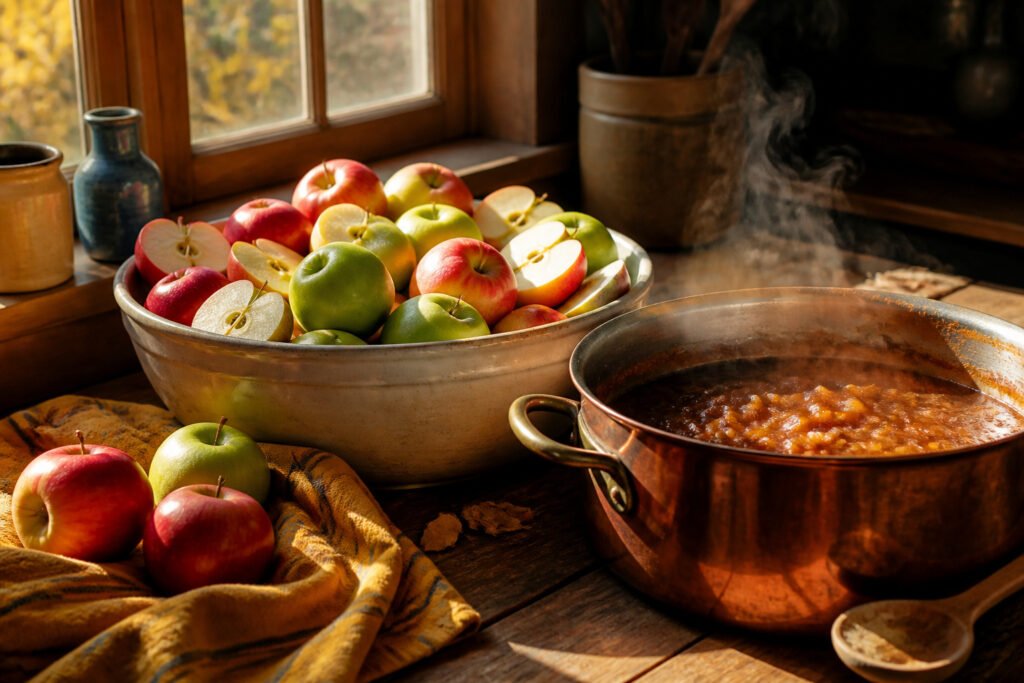
The apples you pick matter most. Go heavy on Fuji or Gala and you can cut the sugar by half; load up on Granny Smith and you will need every cup the recipe allows.
The peels stay on through the whole cook, breaking down to silk in the immersion blender, which is the step that keeps this from being a pot-watching project.
What Apple Butter Is and When to Make It

Apple butter contains no dairy at all. The name comes from its texture, not its ingredients: slow-cooked apples collapse into a thick, spreadable concentrate that resembles soft butter more than applesauce.
The apples, sugar, and spices go into the crockpot as a loose, pale mixture and emerge 10 to 12 hours later as something deep brown and densely flavored, the sugars caramelized and the volume reduced by roughly half.
Late September through November is the practical window. Apples drop to their lowest price of the year, and the kitchen is already running on cinnamon and nutmeg anyway, so the long cook time feels like ambiance rather than work.
The yield runs generous: about 6 pint jars or 12 half-pint jars from a standard batch, which matters when you’re deciding whether the project is worth the counter space.
The sealed jars of homemade apple butter will keep for 8 to 10 months at room temperature.
That shelf stability means the work pays out across a full year of toast, sandwich cookies, and pork loin glaze, not just a week of autumn enthusiasm.
Ingredients

Apple butter asks for a pile of apples and patience, not much else. The base recipe scales wide: 3 to 12 cups of cored and chopped apples, depending how many jars you want out.
I leave the peels on; they cook down to nothing and save the prep time. Mix whatever looks good at the store, Fuji, Gala, Honeycrisp, Granny Smith, or a blend of all of them.
For the full batch, you’ll need:
- 3 to 12 cups cored and chopped apples
- 1/2 to 3 1/2 cups granulated sugar
- 1/2 cup brown sugar
- 4 teaspoons ground cinnamon
- 1/2 teaspoon ground cloves
- 1/4 teaspoon ground nutmeg
- 1 tablespoon vanilla extract
- 1 cup apple cider, optional
That range on the white sugar matters. Some recipes run lean at half a cup, others pile on three and a half.
I split the difference and adjust after tasting the cooked-down apples, since sweetness shifts with the variety. Salt appears in a few versions and I skip it; the spices carry it.
Yield lands at 6 to 8 jars, roughly 1 cup each, with maybe a spoonful left for the cook.
Method
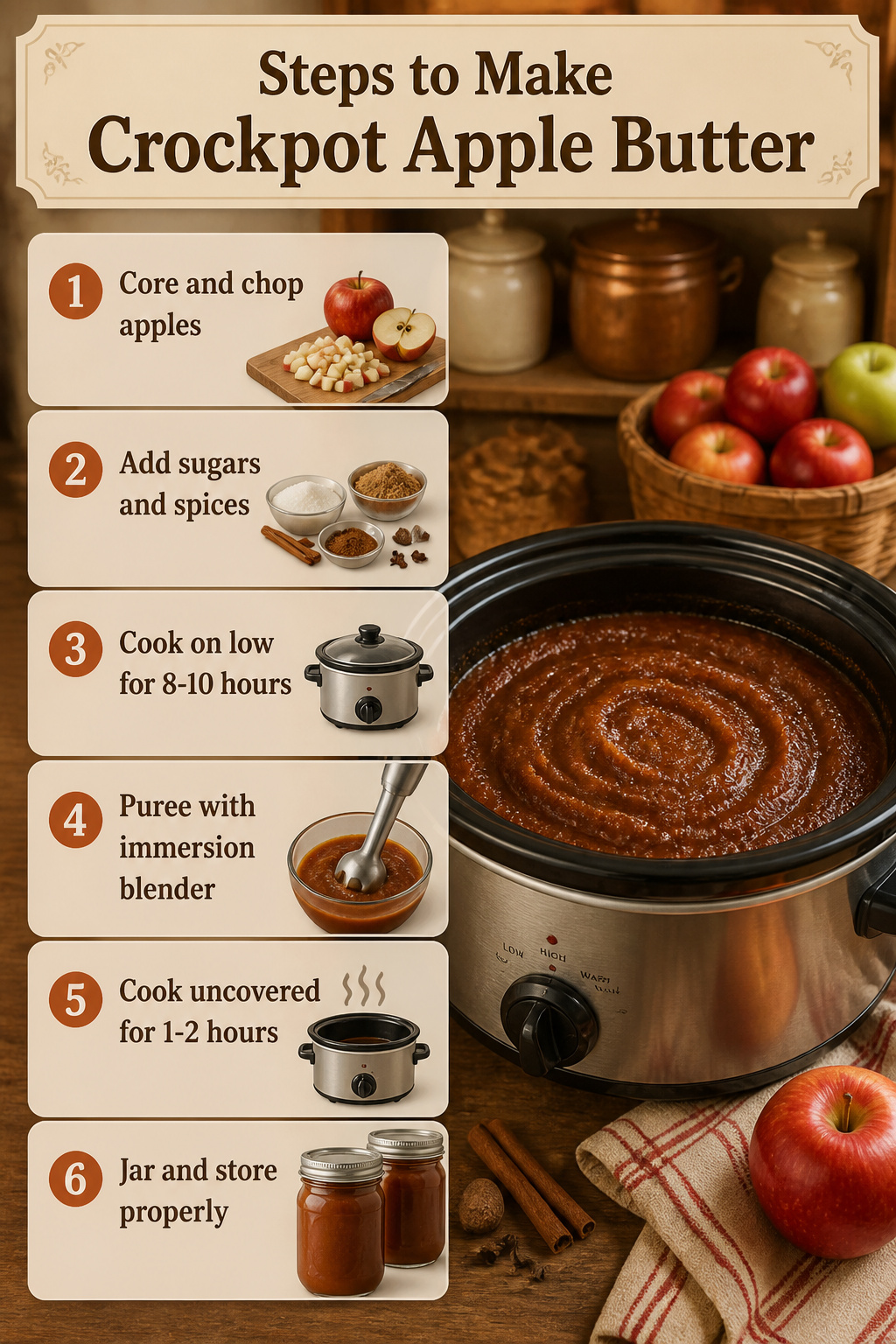
- Core and chop your apples into small pieces, leaving the skins on. The peels soften completely during the long cook and add depth, so skipping that step saves real time.
- Toss the chopped apples into the crockpot with granulated sugar, brown sugar, cinnamon, nutmeg, cloves, and salt. Stir until the fruit is evenly coated and the spices are distributed, not clumped.
- Cook on low for 8 to 10 hours, stirring occasionally. The apples will collapse into a loose, soupy mass the color of dark caramel. That liquid is normal; it reduces later.
- Add vanilla extract, then puree with an immersion blender right in the pot until the mixture is completely smooth. The skins disappear into silk at this stage.
- Leave the lid off and continue cooking on low for another 1 to 2 hours. The apple butter is done when it mounds on a spoon rather than running off, and a dragged spoon leaves a clean trail across the bottom of the crock.
- Ladle into clean half-pint mason jars, leaving ¼ inch headspace if you plan to can. Otherwise, refrigerate for up to 2 weeks, freeze for up to 6 months, or process in a water bath for shelf-stable storage.
Apple Varieties and Sweetness

A mix of sweet and tart apples gives apple butter its depth, and the balance directly controls how much sugar you will need. I reach for Fuji, Gala, or Honeycrisp on the sweet side and add Granny Smith for acidity.
That combination usually means I can cut back on added sugar, since the sweeter varieties bring plenty of their own. Red Delicious and McIntosh work too, but they behave differently in the slow cooker.
McIntosh breaks down almost to sauce, while Red Delicious holds more structure than you might expect through a 10–12 hour cook. Neither is wrong, but they change the texture you start with before blending.
If you go heavy on tart apples, the brown and white sugar in the recipe becomes more necessary; load up on Fuji and Gala and you are already most of the way to sweet.
If you skip this, you will wonder why one batch tastes flat and the next is cloying. The apples you pick are the first decision in the recipe, and it is the one that sets every flavor decision after it.
Cooking Time and Doneness

The 8–12 hour window on low heat gives you two distinct products. At 8 hours, the spread stays lighter and more apple-forward, the kind of thing you want on a biscuit where the fruit still reads as fruit.
Push to 12 hours and the sugars caramelize into that deep amber-brown color and richer flavor that reads as classic apple butter, the sort of difference you notice side by side but might not name without the comparison.
Doneness is easier to judge before you blend. The apples should be very soft, the color visibly darkened, and the mixture should hold a clean line when you drag a spoon through it.
If it pools back immediately, it needs more time. I stir every few hours, mostly to check the edges where the crockpot runs hotter and the sugars can start to stick.
One source suggests the spoon test after cooling slightly; another checks if a spoonful holds when turned over.
Either works, but the line-in-the-pot method lets you test without removing heat, which matters when you’re already eight hours in and deciding whether to push longer.
Blending and Thickening

Once the apples have cooked down to a translucent, falling-apart state, the immersion blender is the tool that keeps this project from turning into a mess.
I stick it straight into the crockpot, no transferring required, which matters because hot apple slurry in a standing blender needs the lid cracked to vent steam and still risks a blow-up if you overfill.
The immersion blender lets me puree in place, and the only caution is keeping the blade submerged so the motor doesn’t fling butter up the backsplash.
Smooth here means no visible flecks of skin or chunk, just a uniform, glossy spread. That takes a minute or two of steady blending, moving the head around to catch the corners.
For thickening, the lid comes off and the crockpot goes back to low for another 1 to 2 hours. Steam escapes, the liquid reduces, and the color deepens.
The test is a spoon drawn across the bottom: it should leave a clean trail that fills in slowly, not immediately. If it rushes back in, give it more time.
Storage Methods
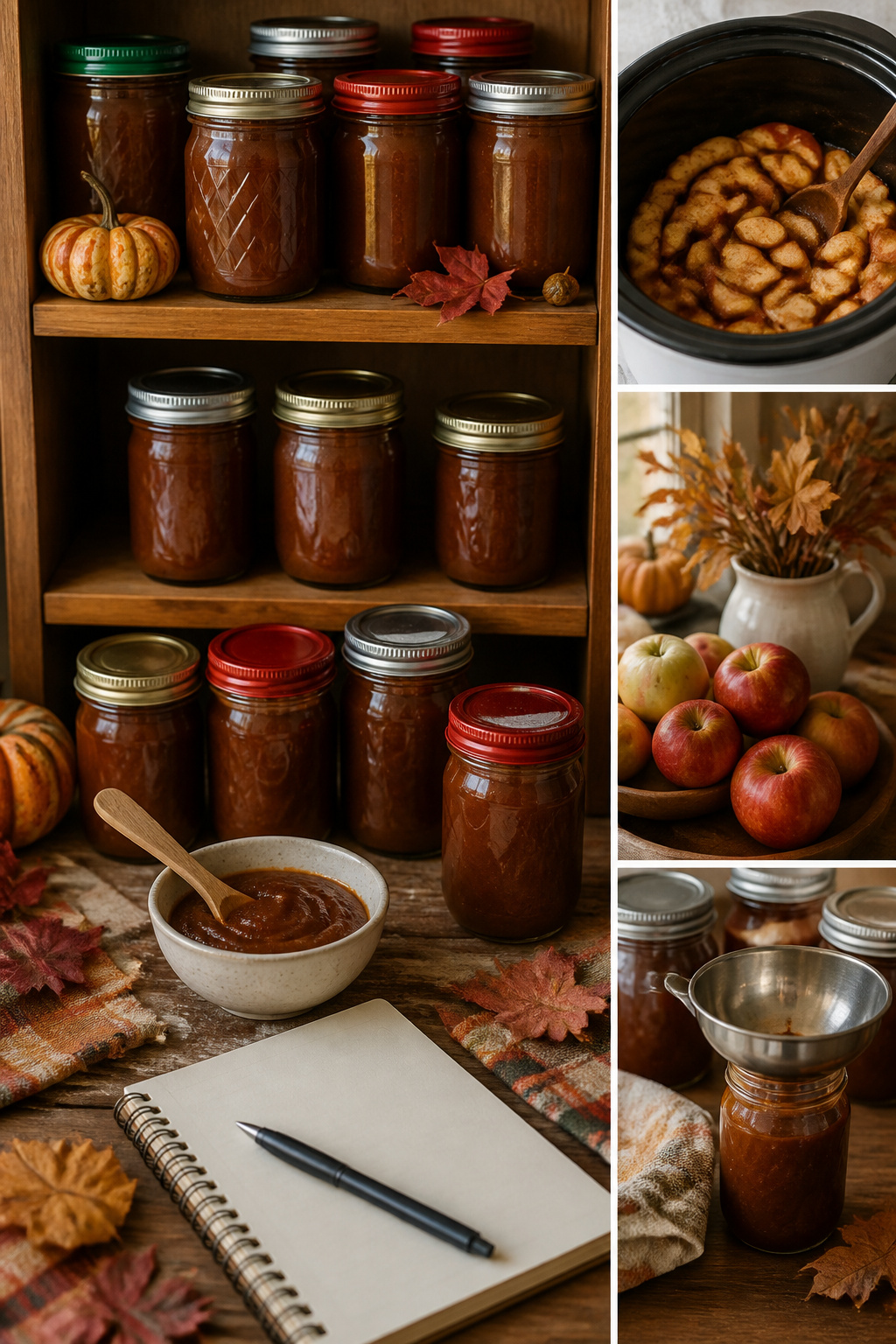
A finished batch of crockpot apple butter gives you three ways to keep it, and the method you pick shapes how long it stays good.
Refrigerated apple butter lasts up to 2 weeks in an airtight container or mason jar. In practice, a 3-quart slow cooker batch disappears faster than that at my house, but the two-week window is the safe mark.
Freezing stretches that to 6 months. Pour it into freezer-safe bags, thaw overnight in the fridge, and stir before using.
The texture may separate slightly after freezing, but it stirs back together without issue.
For shelf-stable jars, water-bath canning is the route. Sterilize your mason jars and lids first, then ladle the hot apple butter straight from the slow cooker while it is still hot.
Leave 1/4 inch headspace, run a knife through to release air bubbles, wipe the rims clean, and seal. Process in a rolling boil for 10 to 15 minutes, then let the jars sit in the pot another 5 minutes off the heat.
Cool for 24 hours before storing. Sealed jars keep 8 to 10 months at room temperature, or up to 2 years by some counts.
Check the seal after cooling; if the lid pops when pressed, that jar goes straight to the fridge and gets used within 3 weeks.
Flavor Variations

Once the base method feels reliable, a few small shifts in the mix are worth keeping in mind.
- A splash of bourbon adds warmth and depth without turning the batch into a cocktail. Stir it in after cooking, not before; alcohol cooks off too easily in a slow cooker left on low.
- Swap part of the white sugar for honey and the spread takes on a lighter, more floral sweetness. The ratio is flexible, though honey burns faster than granulated sugar, so keep the heat on low and watch the edges.
- ¼ teaspoon of ground sage steers the whole jar slightly savory. It pairs with the apples more than it competes, and it works on a cheese board in ways the plain version does not.
These are not in the base recipe, but they are the kind of practical detours that keep one slow-cooker method from feeling like the only one.
Ways to Use Apple Butter

A full batch of crockpot apple butter fills 6–8 half-pint jars, which sounds generous until you realize how fast it disappears.
A jar on the counter with a butter knife is the fastest route: biscuits, toast, or an English muffin straight from the toaster. Whole-wheat works for breakfast; cinnamon-raisin is the afternoon choice.
Either works; the raisin version reads as dessert, the wheat as a meal.
- Stir a spoonful into morning oatmeal or yogurt. Stir a spoonful into oatmeal while it finishes on the stove; it takes no extra time.
- Build a fall sandwich: turkey, brie, and a thin layer of apple butter on sourdough. One source treats this as a seasonal special; the bread choice is yours.
- Set it out on a charcuterie board next to cheese and crackers. Set out the jar with a cheese board for game day or brunch; it looks intentional, not desperate.
- Glaze pork chops or chicken with it in the last few minutes of cooking. The comparison to applesauce is direct; apple butter carries more sugar and less water, so it browns faster. Watch it.
- Bake with it: thumbprint cookies, bar cookies, or a swirl through muffin batter. Apple butter cookies and bars are the specific bakes to try. I would add that it replaces some of the fat and sugar in a standard muffin recipe, though you will need to test the ratio with your usual formula.
Frequently Asked Questions
What apples are best for apple butter?
A mix of sweet and tart apples like Fuji, Gala, or Honeycrisp paired with Granny Smith gives the best depth. Sweeter varieties let you cut back on added sugar, while tart ones need more.
Red Delicious and McIntosh work too, though McIntosh breaks down faster and Red Delicious holds more structure through the long cook.
How long does apple butter last?
Refrigerated apple butter stays good for up to 2 weeks, frozen for 6 months, and water-bath canned jars keep 8 to 10 months at room temperature. If a jar seal fails after canning, move it to the fridge and use within 3 weeks.
Do I need to peel the apples?
No, peeling is optional. The skins soften completely during the 10 to 12 hour cook and blend to nothing when you puree, so leaving them on saves prep time without affecting texture.
Can I make apple butter in a slow cooker?
Yes, a slow cooker is the main method covered here. The low, steady heat lets the apples collapse and caramelize over 8 to 12 hours without tending a stove, and the immersion blender works right in the pot for easy finishing.
How do you know when crockpot apple butter is done?
After the final thickening stage with the lid off, draw a spoon across the bottom of the crock. The apple butter is ready when it leaves a clean trail that fills in slowly, not one that pools back immediately.
It should mound on the spoon rather than run off.