
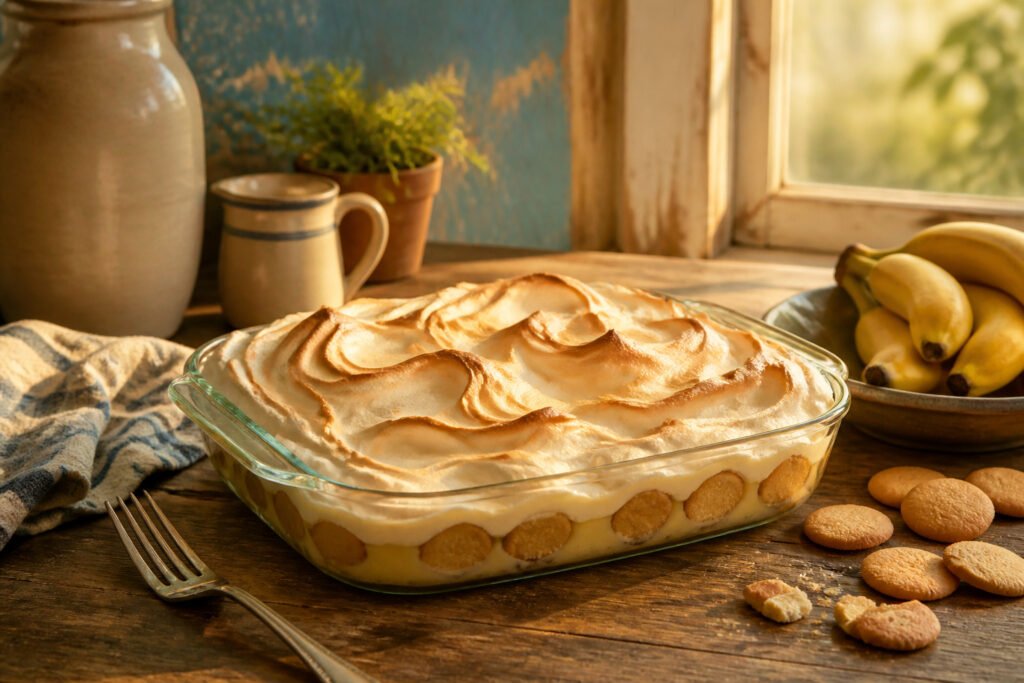
This banana pudding bakes under a meringue that turns golden in 8 to 20 minutes, and the custard needs a full 10 to 12 minutes of low heat and constant stirring so the eggs do not scramble.
The condition that matters is patience: rush the custard and you get flecks of cooked egg; pull the meringue early and it weeps moisture onto the surface later.
I use butter in the custard, not all recipes do, and I build the layers in a two-quart baking dish with Nilla wafers on the bottom where they soften into something cake-like.
Total active time is roughly 45 minutes, plus at least four hours of chilling before the vanilla fully blooms and the texture sets.
Ingredients

The custard base starts with 3/4 cup sugar, 1/3 cup all-purpose flour, and 1/4 teaspoon salt whisked together dry. Four egg yolks and 2 cups milk go in next, cooked over simmering water until thick enough to coat a spoon.
Off the heat, stir in 1 teaspoon vanilla and 2 tablespoons butter.
For assembly and the bake, you will need:
- 45 Nilla wafers, divided (save 10 for the top)
- 4 ripe bananas, sliced into rounds
- 4 egg whites
- 1/2 cup sugar for the meringue
- Butter for greasing a 2-quart baking dish
Some recipes call for a pinch of salt and no butter in the custard; others add cream of tartar to the whites.
I like the richness the butter gives the custard, and I find the sugar alone stabilizes the meringue well enough if you add it slowly once soft peaks form.
Method
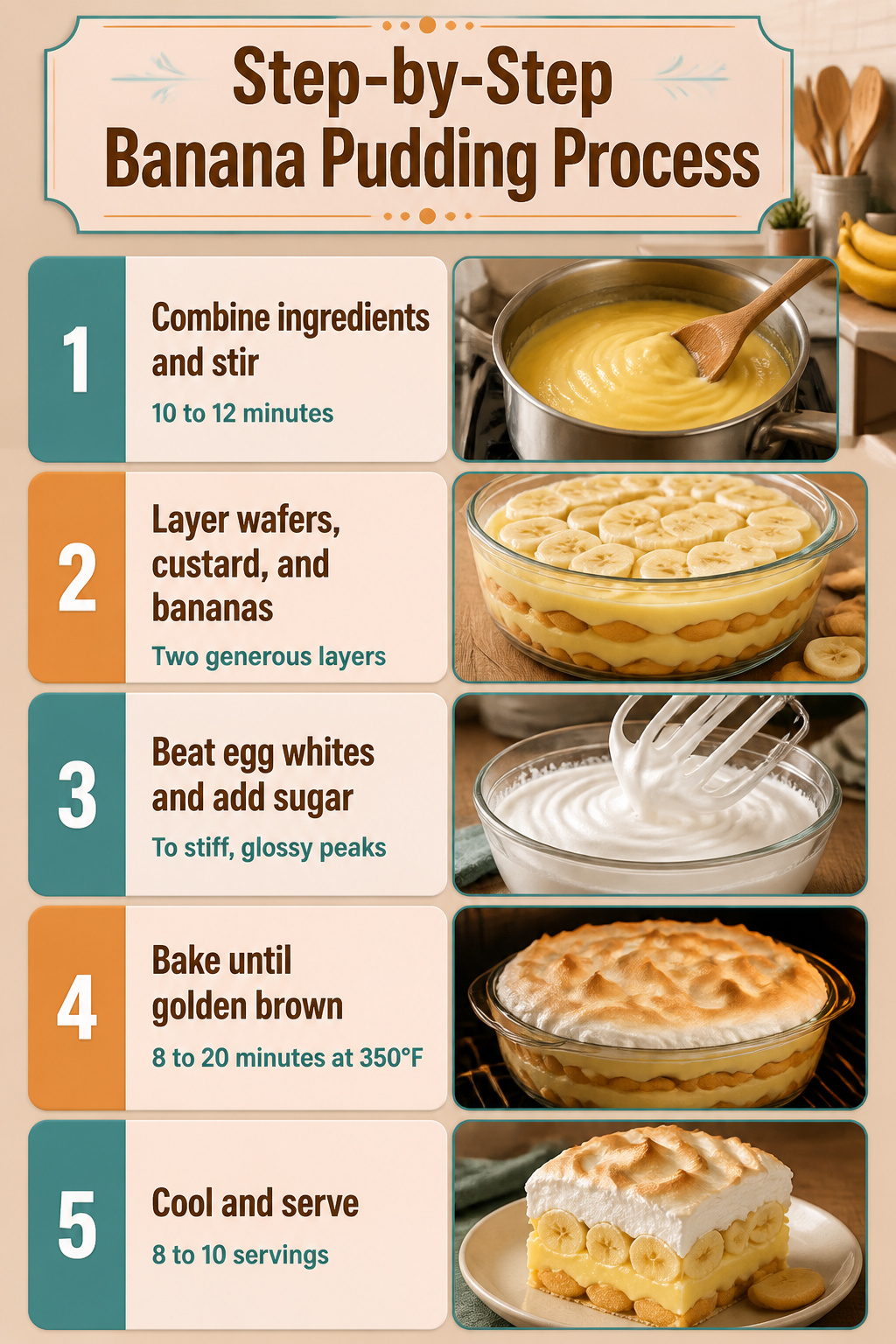
- Set a small saucepan over low heat and combine 1 cup sugar, 6 tablespoons flour, a pinch of salt, 4 egg yolks, 2 cups milk, and 2 teaspoons vanilla. Stir constantly while the custard thickens, which takes a solid 10 to 12 minutes of attention; the low heat keeps the eggs from scrambling. Pull it off the burner and work in 6 tablespoons of butter until it melts smooth.
- Butter a two-quart baking dish, then build layers: vanilla wafers first, custard next, sliced ripe bananas on top. Repeat until the dish is full. Some recipes call for three full layers of each; I find two generous layers in a standard two-quart dish fills it neatly without overflow.
- Beat the 4 reserved egg whites to soft peaks, then gradually add 1/2 cup sugar (plus 1/2 teaspoon cream of tartar if you keep it on hand) and beat to stiff, glossy peaks. Spread the meringue over the pudding, sealing it right to the edges so it does not shrink back in the oven.
- Bake at 350°F until the meringue turns golden brown. The range here is wide: 8 to 20 minutes, depending on how thick you spread it and how brown you like the top. Watch it after the 8-minute mark; meringue goes from toasted to burnt fast.
- Let it cool slightly and serve warm, or refrigerate and serve chilled. Either way, it yields 8 to 10 servings.
What Makes the Custard Work

Custard thickens at a pace that refuses to be rushed. Low heat is the only way to keep the custard smooth; anything higher than medium and the eggs will seize into grainy curds before the starch can save them.
Now I keep the burner low and the whisk moving the full 10 to 12 minutes, watching for the moment the mixture coats the back of a spoon and leaves a clean line when I run my finger through it.
The texture should look like loose pancake batter and feel silky, not gluey.
Some cooks prefer a double boiler, setting the bowl over simmering water to buffer the heat.
I go straight into a heavy saucepan, but the principle is the same: constant stirring is what keeps the eggs from curdling, because hot spots form the second you stop moving.
The custard is done when it barely quivers, still pourable, since it tightens further as it cools between the layers.
Layering That Holds Up

Wafers on the bottom absorb moisture from the custard and soften into a cake-like layer, which is why the dish works at all.
I lay them flat in a single layer across the base of a two-quart baking dish, edges touching but not forced to overlap; the custard seeps through the gaps and binds everything together.
Banana slices should be about a quarter-inch thick, thick enough to stay intact when you spoon through the dessert but not so bulky they slide around.
In a two-quart dish you get three full layers of wafers, custard, and bananas before you reach the rim, with the final custard layer sitting just below where the meringue will go.
Some cooks stand extra wafers upright around the edge for decoration, which looks nice but serves no structural purpose; the custard does not grip them as securely, and they stay harder than the soaked bottom layers.
I skip it and save the remaining wafers for crumbling on top after baking, or just eat them while the meringue browns.
Meringue to Bake

Egg whites whip best at room temperature, and a clean, dry bowl matters more than whether it is glass or metal.
I start the mixer on medium until the whites turn foamy, then bump the speed and watch for soft peaks that fold over when I lift the beater.
Once the whites hold a soft peak that folds over when you lift the beater, start adding sugar a spoonful at a time so it dissolves instead of leaving grit throughout.
Once the last granule disappears, the whites should hold stiff peaks that stand straight and glossy, not dry or clumped.
Spread the meringue immediately while it is still warm from the beating, sealing it to the custard at the edges so no gap forms. A spoon or offset spatula works; swoops and peaks brown more dramatically than a flat slab.
Bake at 350°F for 8 to 20 minutes, depending on how dark you want the top. The range is wide because ovens vary and because some people want only a light toast while others want almost burnt.
The meringue is done when the peaks turn the color of a well-baked marshmallow and the surface feels dry to a light touch.
Underbaked meringue will weep later as the uncooked egg proteins continue to settle and squeeze out moisture, so if the center looks wet or the peaks still feel squishy, give it another two minutes rather than pulling it early.
Chilling and Serving

Cold pudding tastes flat. The custard needs at least four hours, preferably overnight, for the vanilla to bloom and the wafers to soften into that cake-like layer people fight over.
I pull mine out twenty minutes before serving so the chill dulls the sweetness less.
The meringue weeps if it sits more than a day, so bake it the morning you serve and keep the dish loosely tented with foil, not sealed. Plastic traps condensation that collapses the peaks.
For a Saturday party, Thursday night is your custard-and-assembly window; Friday stays hands-off.
Garnishes should crack or snap, not melt. A stack of extra wafers propped at one end lets guests crumble their own.
Shaved chocolate works only if the kitchen stays cool; otherwise it greases into streaks I find worse than nothing. A few coarse salt flakes on the meringue edge wake the banana up without reading as salty.
Leftovers hold two days before the bananas brown through and the wafers dissolve entirely. The flavor’s still there, but the texture becomes spoonable mush.
I eat it standing at the fridge and don’t apologize.
Frequently Asked Questions
What is the best way to layer banana pudding?
Start with vanilla wafers flat on the bottom, pour custard over them, then add sliced bananas on top. Repeat until the dish is full; two generous layers fill a standard two-quart dish neatly without overflow.
How long do you bake banana pudding?
Bake at 350°F for 8 to 20 minutes until the meringue turns golden brown. Watch it closely after the 8-minute mark, because meringue goes from toasted to burnt quickly.
Can you make banana pudding vegan?
Yes, though this particular recipe uses eggs and dairy. Some recipes replace the dairy with coconut milk and thicken the custard with cornstarch instead of egg yolks.
How to make 4 ingredient banana pudding?
This recipe uses more than four ingredients, but the core components are custard, bananas, vanilla wafers, and meringue. You could simplify by using instant pudding mix, store-bought whipped topping, bananas, and wafers.
What is the secret to good banana pudding?
Low, slow heat and constant stirring while cooking the custard, which keeps the eggs from scrambling or curdling. Give the assembled pudding at least four hours, preferably overnight, in the refrigerator so the wafers soften and the vanilla flavor develops.
What are the five ingredients in banana pudding?
Traditional banana pudding centers on five basics: custard, bananas, vanilla wafers, meringue, and sugar. This recipe adds flour, butter, vanilla, and salt to build the custard and stabilize the meringue.
What are the ingredients in Dolly Parton’s banana pudding recipe?
This recipe is not Dolly Parton’s, though it shares the classic Southern style of layered custard, bananas, and meringue over vanilla wafers. Her version may differ in proportions or technique.