
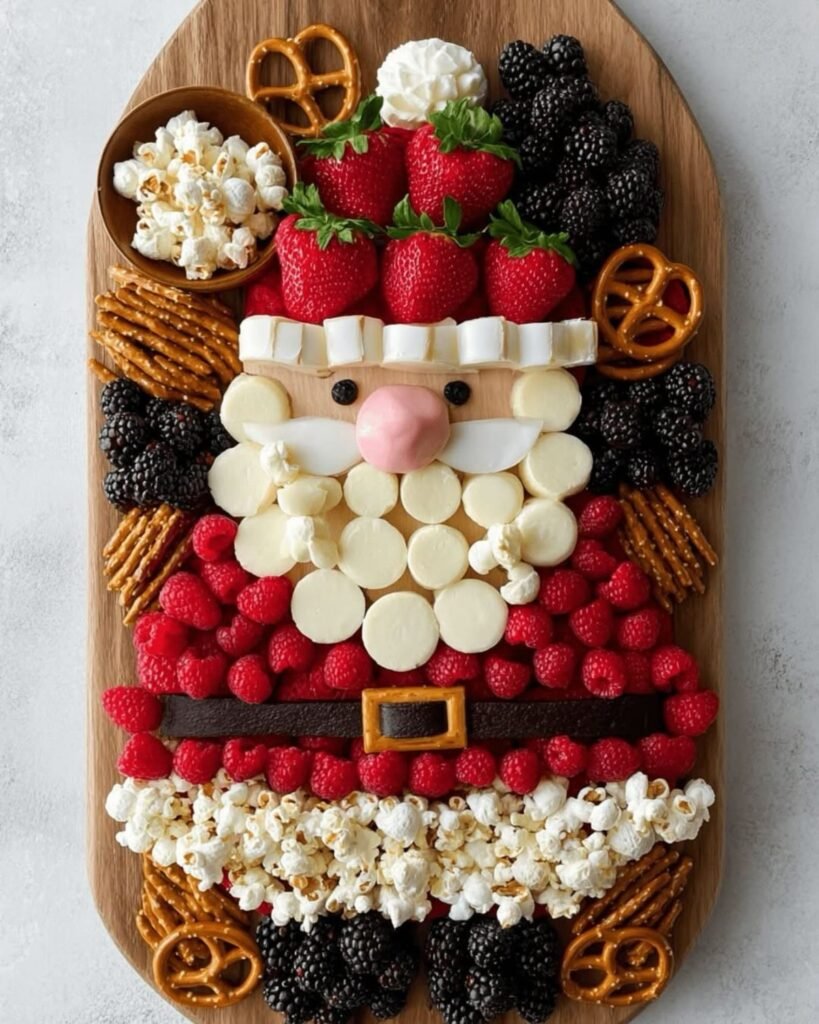
These 16 Christmas charcuterie board ideas run from a 10-minute caprese skewer assembly to a full grazing table that turns your whole buffet surface into the spread.
The deciding factor is your guest count and how much hands-on time you want: a shaped board for a dinner party, individual boxes for a couch-and-fireside gathering, or a hot chocolate setup when people want something warm after a long evening.
What holds every option together is that none require a rented display piece or a catering degree; even the meat roses come from folding salami into a wine glass you already own.
1. Christmas Tree Charcuterie Board

Shaping the whole appetizer into a tree makes it the centerpiece without needing anything else on the table.
I like this one for hosts who want the wow factor without renting extra display pieces; the tree shape does the decorating for you.
Start with any board you already own, rectangular or round, and build the triangle from the bottom up. Alternate rows of meat and cheese, or mix them if you prefer a less regimented look.
Cut cheese into triangles that point toward the top, and tuck rosemary sprigs between layers so the green reads as branches. A star-shaped piece of cheese on top finishes it.
For the star, press a small cookie cutter into a firm white cheese. Pomegranate arils scattered through add the red, and a celery stalk at the base stands in for a trunk if you want one.
You’ll impress your guests and add a bit of holiday magic to just about any party of the season. Don’t forget to serve it up with your favorite Christmas wine!
2. Dessert Charcuterie Boards

Dessert charcuterie boards swap every savory element for sweets, which makes them the natural move when your dinner already filled everyone up or when you are feeding kids who will ignore the aged Gouda anyway.
Load a wooden board with cookies, candy canes, chocolate bark, marshmallows, and whatever holiday treats you have on hand. Store-bought is fine; the visual impact comes from variety, not from staying up baking.
Add a bowl of chocolate ganache or warm caramel for dipping, and tuck in some fresh fruit if you want to break up the sugar.
I have seen these done with everything from frosted sugar cookies to Peeps to pretzel rods, and the only real rule is to keep colors in the holiday range.
3. Cheese Variety

Cheese variety matters more than cheese quantity. A few good selections beat a crowded board where half the wedges go untouched because no one knows what they are.
A classic three-cheese Christmas charcuterie board combines brie, aged cheddar, and goat cheese. That gives you a soft, a hard, and a tangy option, which covers most preferences without requiring a cheese shop degree.
For a Christmas color scheme, white cheeses like Brie and goat cheese read clean against red meats and green herbs. Cut them into different shapes, cubes and triangles both, so the board does not look like a deli counter.
Bocconcini, those small mozzarella balls, work as white ornaments on a wreath or tree board if you are building one of those shapes.
4. Christmas Wreath Charcuterie Board

A wreath charcuterie board solves the problem of round boards, which otherwise just look like any other appetizer platter. The shape reads instantly as Christmas, and rosemary gives you real fragrance while people are grazing.
Form a circle of rosemary sprigs around the outer edge of your board, letting them overlap slightly so the green looks lush.
Tuck cheeses and meats between and slightly under the herb so the food stays in place and the rosemary reads as the frame.
Cherry tomatoes or red grapes fill the berry role; cucumber slices add pale green texture if you want more contrast.
A red pepper ribbon and bow, cut from roasted pepper strips, marks the top the way a real wreath hanger would.
The whole thing takes only a little longer than a standard board, and the result photographs like you planned it for days.
5. Meat Roses

Meat roses look like they require a catering degree, but they are just salami folded into a wine glass and then flipped out.
I learned this the hard way: my first attempts looked like collapsed carnations until I used a stiffer cured meat and a narrower glass.
Lay a slice of salami across the rim of a small glass so half hangs over. Lay another slice overlapping it, and keep going until you have a small stack of slices to fold into a rose.
Press the center down gently, then flip the whole thing onto the board and lift the glass off. Finocchiona, soppressata, and pepper-coated salami all hold their shape well; prosciutto does not, so save that for draping elsewhere.
Arrange the roses on a gold or dark board where the color pops, and add rosemary sprigs as filler greenery.
6. Santa Charcuterie Board

A Santa charcuterie board is the one to pull out when there are kids in the room, though adults usually photograph it first.
The color scheme does all the work: red and white, with a little pink skin tone if you are being precise.
Build Santa’s face in the upper center using white cheese or hummus for the beard and trim, red meats or bell peppers for the hat, and a small round of Brie or a dollop of white dip for the pom-pom.
Chorizo and coppa give you the red without dyeing anything. Scatter strawberries or cherries through the lower board as filler that keeps the palette.
Two hands reaching in, one adult and one child, is the photo you will end up with; plan the layout so the good stuff sits where fingers naturally land.
7. Candy Cane Charcuterie Board

A candy cane charcuterie board turns the holiday shape into a serving guide, which makes assembly faster than a free-form spread because the stripes do the arranging for you.
Build the cane on a rectangular wooden board, working in diagonal rows of red and white. Pepperoni, chorizo, or cherry tomatoes give you the red; mozzarella balls, brie cubes, or white cheddar fill the white spaces.
Rosemary sprigs between the rows add green that reads as festive without breaking the color pattern. Mini candy canes and peppermint bark at the curve end signal the shape to anyone who has not seen it yet.
Precubed cheese and sliced meats from the deli case cut prep down to almost nothing.
8. Hot Chocolate Charcuterie Board

A hot chocolate charcuterie board trades meat and cheese for mugs and toppings, which works when your gathering runs late and people want something warm rather than another plate of salami.
Set a wooden board with hot cocoa bombs, marshmallows, crushed peppermint, and mints as the center, then arrange candy-striped spoons and mugs around it so guests build their own.
I like this for groups with mixed ages; kids pile on marshmallows while adults reach for the dark chocolate bombs. Keep a thermos of hot milk or water just off the board so the setup stays neat.
The whole thing takes one trip to the grocery store and barely any time to arrange.
9. Reindeer Charcuterie Board

A reindeer charcuterie board gives you a face to build around, which helps if you are nervous about free-form arranging because the features tell you where each ingredient goes.
Start with a wedge of brie for the face, centered on a wooden board. Two olives become eyes; a cherry tomato or cranberry sits as the nose.
Pecans and rosemary sprigs fan upward as antlers, and the rest of the board fills with cured meats, crackers, and berries the way you would any spread.
The face uses items you are already serving, so nothing goes to waste when people start grazing. I have seen this done with a camembert round too, which spreads the face wider if your board is large.
10. Caprese Skewers

Caprese skewers pull the classic tomato-mozzarella-basil stack off the plate and onto sticks, which makes them easier to pick up at a crowded party where everyone is holding a drink.
Thread 1 cherry tomato, 1 small mozzarella ball, and 1 basil leaf onto each skewer, in whatever order looks balanced. Wait to add olive oil or balsamic reduction until right before you serve so the basil stays perky.
The red-white-green reads as Christmas without any extra decoration, which is why I reach for these when I need something fast that still photographs.
11. Sugared Cranberries

Sugared cranberries look like frosted ornaments on a board, and they are the one sweet element that does not compete with the cheese.
Roll fresh cranberries in simple syrup, then in granulated sugar, and let them dry until the coating sets hard. They hold up well enough that you can make them ahead.
On a board with salami roses and sliced cheeses, the red sugar berries add color where another meat would crowd the spread. I add them to dessert boards too, where they bridge the gap between cookies and fruit.
The tart center cuts through rich cheese if a guest eats them together, which some always do.
12. Snowman Charcuterie Board

A snowman charcuterie board needs an oval board to get the right proportions, which is worth buying if you host often; the shape works for football spreads later too.
Build the body in 3 sections: popcorn for the base, white cheese cubes for the middle, and blueberries or dark berries for the head. Pretzels make arms, and a small honey jar serves as a hat if you want one.
Surround the figure with crackers, fruit, and whatever fills your crowd out to the board edges. I like this for afternoon gatherings where people graze over hours; popcorn is lighter than meat after the third handful.
The whole setup uses only snacks, no cooking, and comes together fast.
13. Holiday Grazing Table

A grazing table turns your whole buffet surface into the appetizer, which suits hosts who expect 20 or more and do not want to refill a board all evening.
Spread butcher paper or a clean table runner across the surface, then cluster cheeses, meats, and breads in themed zones: spicy cured meats in one corner, creamy dips with crackers nearby, sliced baguette and flavored oils in another.
Red candles and evergreen garlands fill gaps between clusters so the food reads as decoration too. Guests circulate and pick what they want, which keeps you out of the kitchen.
14. Slate Board with Holiday Accents

Slate’s dark surface makes colors pop the way wood cannot, which is why I reach for it when the board itself needs to feel like the special occasion piece.
Arrange fruits, crackers, and shaped cheeses on the black surface; reindeer, Santa hat, and tree shapes are just pressed cookie cutters into firm cheddar or white cheese, nothing more. Decorative picks add height without requiring stands.
The cool surface keeps cheese firm longer than wood, so this board holds up better at room temperature through a whole party. Miniature holiday decorations tucked between items signal the season without competing with the food.
15. Nutcracker Charcuterie Board
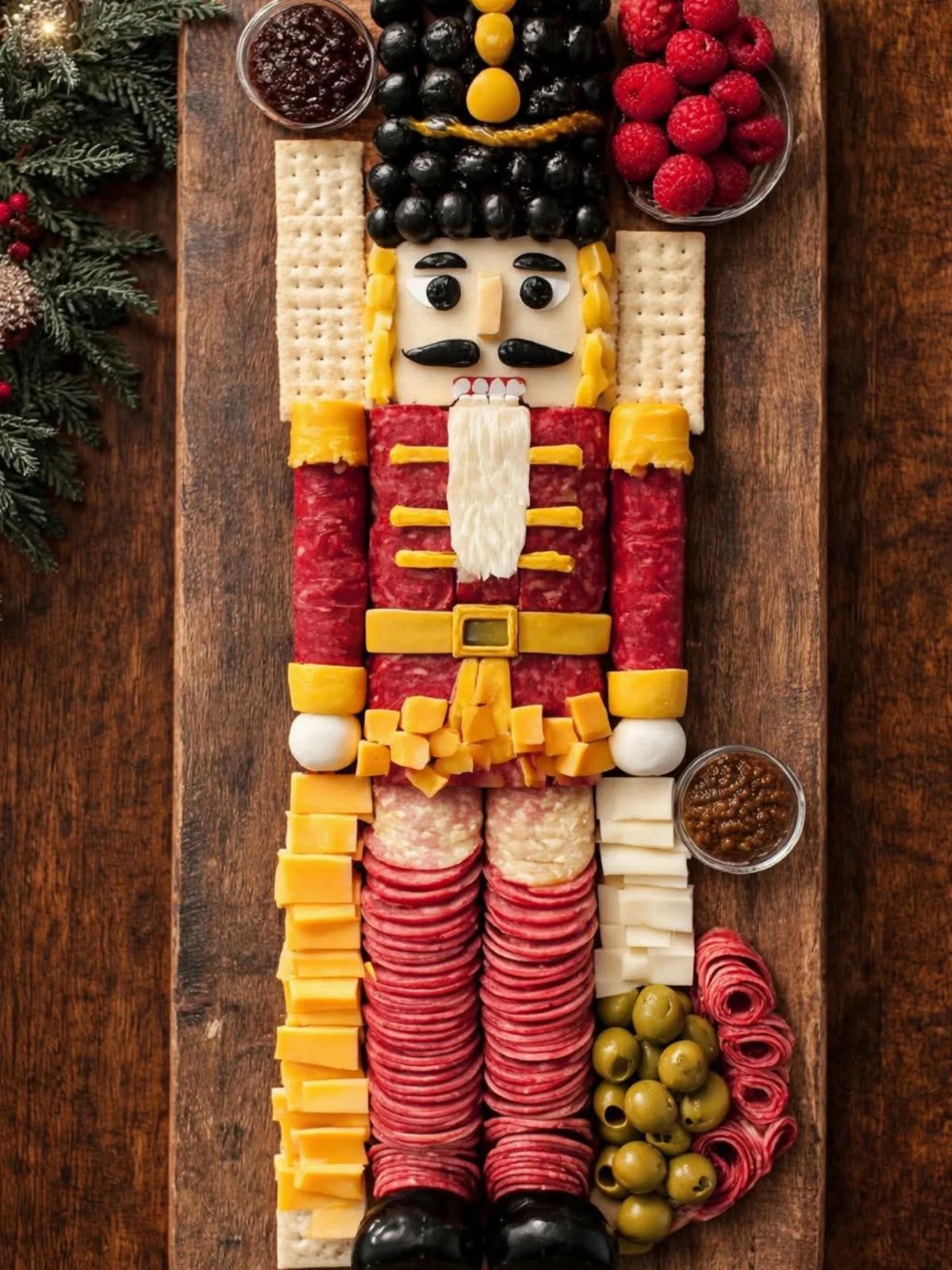
A nutcracker board gives you a vertical face to build, which breaks the flat-board habit and photographs surprisingly well from above.
Start with a rectangular wooden board and map the soldier in sections: salami or chorizo for the red jacket, sliced white cheese for the face and trim, black olives for eyes and boots, and a cracker or breadstick as the upright rifle.
Build this from standard charcuterie items already on hand; no special shopping required. I find this easier than Santa because the soldier’s uniform is geometric, not curved.
One olive sliced in half makes the mustache if you want that detail.
16. Individual Holiday Charcuterie Boxes

Individual boxes solve the crowding problem at small gatherings where everyone hovers over one board, and they let guests carry their snack to a couch or fireside chair without committing to the whole spread.
Fill small boxes or lidded cups with a couple cheese varieties, a handful of crackers, a small cluster of grapes, and a mini jam jar each. Tuck a salami rose in the corner of each box for height and color.
A gingerbread man makes a sweet closer; add one per box or skip it for savory-only guests. The lids mean you can build these ahead and stack them, and assembly goes fast once you have a rhythm going.
Tips for Assembling Boards
A board stays organized if you think in threes: three meats, three cheeses, three fruits or vegetables, and three starches to carry them. That is enough variety without the spread looking like a grocery store display.
Fresh herbs do more than look pretty. Rosemary between meats, thyme tucked near soft cheese, or sage leaves framing a corner all read as intentional decoration, and they cost less than buying props.
Some fruits brown fast and wreck the whole effect. Apples need a toss in lemon juice; bananas, pineapple, and melon are better left off entirely.
Cooked vegetables go soft and sad on a board, so stick with raw or quick-blanched.
If you want heat, serve spicy items off to the side with a label, since guests will not know what they are biting until it is too late.
Winter citrus, candied nuts, and pomegranate seeds add seasonal color without extra shopping trips for specialty items.
Serving Suggestions
Cheese needs roughly an hour at room temperature before it tastes like itself; cold cheddar is just waxy.
I start assembling well before guests arrive, which gives me buffer time if the phone rings or the dog needs out; by the time people walk in, the cheese has lost its fridge chill and the flavors have opened up.
Dessert boards are the exception. Cookies hold fine, and fudge keeps for weeks in the freezer, but the full arrangement should wait until the last minute so nothing goes stale or soft.
Dips stay good in the fridge for a week or two, so those can be made ahead.
Cover the board loosely with plastic wrap once it is built, not airtight, so the cheese can still breathe. Pull the wrap off right before the doorbell rings.
For long parties, I keep backup ingredients in the kitchen and refill in waves rather than loading everything at once; a half-empty board looks picked over, but a refreshed one looks abundant.
Dietary Considerations
A separate cheese board handles vegetarians without making them hunt for the few meatless corners of a mixed spread.
I build it on its own slate or wood surface, with the same variety of soft and hard cheeses, plus nuts and fruit to fill gaps.
Rice crackers and gluten-free pretzels cover the gluten-free crowd; most cured meats are naturally fine there, but check labels if you are not sure.
For kids, star-cut cheese and bite-sized portions turn grazing into something they actually want to pick up.
Budget does not have to mean sparse. Two affordable cheeses, one cured meat, and seasonal fruit arranged with care look more abundant than a crowded board of expensive items thrown together.
The trick is spacing, not spending.
I label anything that might surprise someone: a spicy mustard, a nut-containing cheese, a plant-based spread that looks like the real thing.
Visual Appeal
Picks with stars or small trees skewer cheese cubes nicely; they add a little height and save guests from fishing with their fingers.
Contrast is what catches the eye from across the room. Smooth brie next to rough crackers, glossy grapes against matte nuts, round berries beside angular cheese triangles.
I think in opposites when something looks flat.
Small bowls for dips or jams break up the surface and let you add color in controlled spots. A red pepper jelly in a white bowl becomes its own focal point without spreading where it should not.
Frequently Asked Questions
What are some good Christmas-themed foods to serve at a party?
Cured meats, cheeses, fruits, nuts, and festive sweets all work on a holiday board. Red meats, white cheeses like Brie or fresh chèvre, and green herbs such as rosemary hit the Christmas palette without overthinking it.
Sugared cranberries, pomegranate seeds, and winter citrus bring seasonal color and most grocery stores stock them through December.
What types of things go on a charcuterie board?
A standard board carries cured meats, cheeses, fruits, nuts, crackers, and dips. Fresh herbs do decoration duty cheaper than bought props, and star-cut cheese or shaped meats turn standard items into something guests actually want to pick up.
Is it cheaper to make or buy a charcuterie board?
Making your own is usually more cost-effective, especially for larger gatherings. A tight selection of two budget cheeses, one good cured meat, and whatever fruit is in season will outshine a cluttered pile of expensive items that fight for space.
The spacing matters more than the spending.
What is the 3-3-3 rule for charcuterie boards?
The 3-3-3 rule means three meats, three cheeses, and three starches or accompaniments on every board. I also add three fruits or vegetables to round it out.
The rule keeps you from overcrowding, which helps the board look abundant rather than messy.