
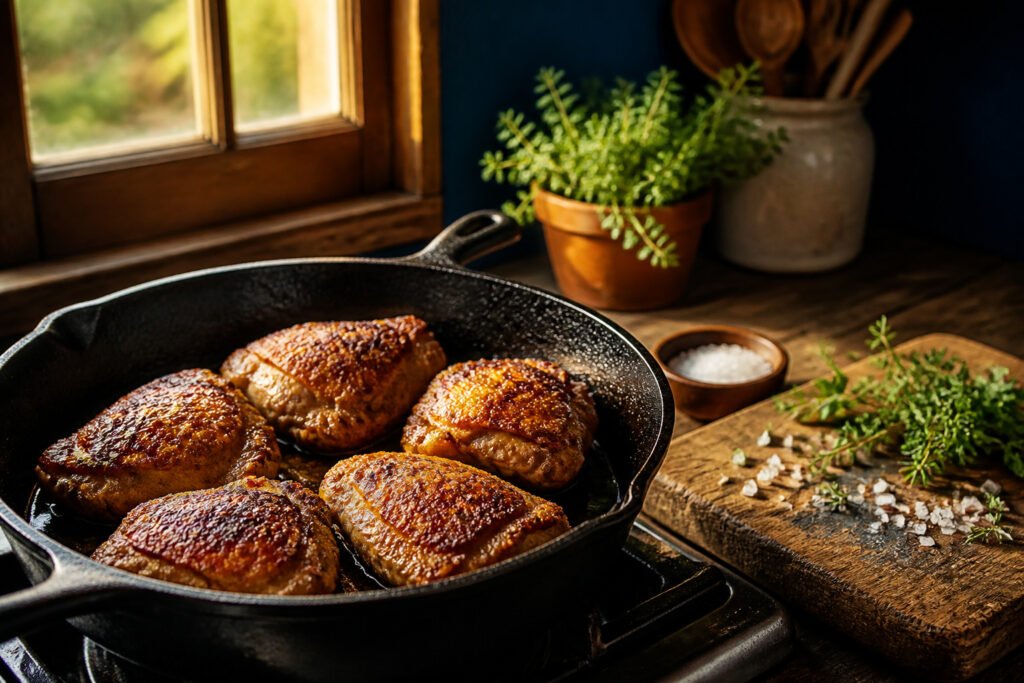
Air fryer chicken thighs are bone-in or boneless pieces cooked in a countertop convection oven that crisps skin with circulating hot air instead of submerging it in oil.
Moisture is the real enemy here: any water left on the surface steams the skin into rubber before the fat can render, which is why the thirty seconds spent patting the chicken completely dry with paper towels matters more than the seasoning you choose.
I learned this the hard way when rushed thighs came out pale and half-steamed, and no extra minutes in the basket rescued them.
Preheat the Air Fryer

Most air fryers call for 375°F to 400°F, and that spread matters more than recipes let on.
At 375°F, the fat under the skin has time to render before the outside scorches, which saves you from chicken that looks bronzed but chews rubbery.
At 400°F, you get a faster crust and a shorter window before the smoke point of any stray drippings sets off your alarm.
My own machine runs hot, so I land at 380°F and let it run empty for three to five minutes.
The blast of dry heat hitting the chicken the instant it touches the basket is what separates crisp from merely brown.
Skip this step and the first few minutes become a steam bath while the cavity catches up, and skin never recovers from that head start in moisture.
The New York Times recipe starts at 375°F, which tracks if your fryer is calibrated true. Mary’s Whole Life pushes to 400°F, a workable gamble if you are watching the timer like a hawk.
Kathleen Ashmore splits the difference at 390°F. Any of these landing points works; the mistake is trusting the dial without knowing your own unit’s temperament.
Pat the Chicken Dry

Water on the surface of chicken thighs turns to steam in the hot air fryer, and steam softens skin instead of crisping it. Moisture is the enemy of crisp skin.
I lay the thighs on a cutting board, press a folded paper towel against the top, flip and do the other side, then check the crevices where the joint meets the thigh.
Properly dried thighs look matte, almost dull, and the skin feels tacky rather than slick.
When I rushed this step once, skipping the second towel and leaving the meat visibly damp, the skin came out pale and rubbery, half-steamed in its own surface moisture, and no amount of extra minutes in the basket rescued it.
The thirty seconds of patting is not a step to skip.
Season or Marinate

Dry rubs and wet marinades both work, but they behave differently in the air fryer’s circulating heat.
A dry blend of sweet paprika, garlic powder, onion powder, dried oregano, salt, black pepper, and a pinch of cayenne builds a thin, crackling crust without adding moisture that needs to evaporate first.
I keep the ratio simple: one teaspoon each of paprika, garlic powder, and onion powder for roughly a pound and a half of boneless thighs, then half that amount of oregano and salt, with chili powder and cayenne to taste.
Wet marinades need more patience.
The combination of soy sauce, honey or maple syrup, balsamic vinegar, Dijon mustard, and fresh garlic carries more flavor deeper into the meat, but thirty minutes is the absolute floor and two hours changes the result noticeably.
Skinny Taste’s approach of reserving half the marinade to reduce into a finishing glaze solves the problem of drippings burning in the basket; excess liquid dumped straight into the fryer will scorch.
The sugars in honey or maple syrup will darken faster than dry seasoning alone, so the visual cue of "golden brown" arrives before the interior hits 165°F; trust the thermometer, not the color.
Arrange in a Single Layer

Skin-side up is the move for bone-in thighs; boneless pieces can lie flat. The real rule is no stacking, no overlapping.
Crowding traps moisture between the pieces, and that steam softens the skin you just spent time drying. My 5.8-quart basket holds 4 bone-in thighs comfortably, or 5 to 6 boneless if they are trimmed to a similar thickness.
Any more than that, and the hot air cannot circulate underneath, so the bottom stays pale while the top over-browns.
I have tried squeezing in a fifth bone-in piece to save a second batch. The skin on the two center thighs never crackled; they came out poached instead of roasted.
Now I split larger batches without debating it.
The flip comes at the halfway mark, which the next section covers. For now, arrange what fits with space around each piece, then close the drawer and let the air do its job.
Cook and Flip Halfway

Boneless, skinless thighs need 10 to 20 minutes at 375°F–400°F, while bone-in, skin-on ones run 22 to 25 minutes at the same range.
The midpoint flip is non-negotiable; that is when the rendered fat on the bottom side gets its chance to crisp on top.
The sound you want is a light, dry sizzle, not a wet sputter. The smell shifts from raw poultry to something roasted and faintly nutty around the ten-minute mark.
I once pulled the basket at eight minutes because the kitchen smelled done. The top side looked golden, but the underside was still pale and sticking to the grate.
Those two minutes I stole cost me the crust; the second half of the cook never caught up. Now I set a timer and do not lift it until the flip.
Check Internal Temperature

Aim the probe at the thickest part of the meat, sliding it in from the side so the tip sits in the center of the flesh without touching bone. Bone conducts heat differently and will trick the reading.
165°F is the minimum safe temperature, and at that point the juices run clear when you pierce the flesh and the meat feels firm to the touch, not springy.
I used to set a timer and call it done, trusting the clock because the skin looked golden enough. The center came out slightly opaque and rubbery, and I ended up finishing pieces in a hot pan while everyone waited.
A $12 instant-read thermometer fixes that entirely. For dark meat, some cooks push to 175–180°F, which still stays juicy and gives a more forgiving texture if you overshoot by a few degrees.
Rest Before Serving

Resting the thighs before you cut into them is where the moisture is won or lost. The source material notes 5 minutes as the standard rest, though 3 minutes still buys you most of the benefit if guests are circling.
What happens in those minutes is straightforward: the muscle fibers relax and the juices, which have been driven to the center by the hot air, get a chance to flow back outward.
Slice too early and those same juices hit the cutting board instead of staying in the meat.
Two thighs from the same batch, both pulled at 165°F, prove the difference: the one sliced immediately leaves a pool on the board, while the one that sits for 5 minutes barely weeps.
The difference on the plate was the line between moist and dry, even though both had been cooked identically. The rest costs you nothing but time, and it is the cheapest insurance in the whole recipe.
Bone-In vs. Boneless Cooking Times

Bone-in thighs take 22–25 minutes at 400°F, while boneless ones finish in roughly 10–20 minutes. The gap comes from the bone slowing heat transfer to the center, though it also shields the meat from drying out.
Skin-on bone-in thighs crisp better because the fat renders longer; boneless pieces can still get crunchy, but the window between golden and overcooked is narrower.
| Attribute | Bone-In Thighs | Boneless Thighs |
|---|---|---|
| Time at 400°F | 22–25 minutes | 10–20 minutes |
| Temperature flexibility | Wider; harder to overcook | Narrower; watch closely |
| Crispiness potential | Higher; longer render time | Moderate; quicker dry-out risk |
| What I buy | Weeknights when I want set-it-and-forget-it | Weekends when I need the plate done fast |
I keep bone-in for Sunday dinners where the extra time is not a problem. Boneless lands in my cart on Tuesdays when I forgot to start dinner until 6:15.
Marinades and Seasonings That Work

The same marinade ingredients show up across recipe after recipe, so the overlap is worth trusting.
Soy sauce, honey, garlic, and balsamic vinegar form the base I see most often, with maple syrup swapped in about half the time and Dijon mustard showing up as a sharper alternative.
Sriracha or cayenne handles the heat depending on whether you want wet or dry.
For dry rubs, the lineup is even more consistent:
- Paprika, garlic powder, onion powder, salt, and black pepper appear in nearly every version, with oregano or Italian seasoning rounding it out
- One combination adds dry mustard powder and cayenne for a sharper bite
- Another keeps it simpler: just kosher salt, black pepper, onion powder, garlic powder, paprika, and dried oregano
My own go-to splits the difference.
I use soy sauce, honey, and garlic when I have twenty minutes to marinate, or I pat the thighs dry and hit them with paprika, garlic powder, onion powder, oregano, salt, and black pepper when I do not.
The dry rub actually crisps better; the marinade can pool in the basket and steam the skin instead of browning it.
Storage and Reheating

Leftover air fryer chicken thighs keep their edge for about 3 to 4 days in the refrigerator, provided they go into an airtight container only after they’ve cooled completely.
Crowding the container is the mistake that costs you the crisp skin you worked for, so lay them in a single layer if you can spare the shelf space.
The air fryer at 350°F for 4 to 6 minutes brings the skin back to something like its first-day crunch. A microwave will warm the meat through, but the skin turns flabby and the rendered fat goes soft again.
That texture is a trade I only accept when I’m eating at my desk between calls and the extra four minutes would mean cold chicken anyway. For a proper plate, the air fryer is worth the wait.
Why Air Fryer Thighs Work

Chicken thighs carry enough fat to stay forgiving when the heat climbs, which is why they work so well in an air fryer.
Breast meat tightens and dries past 165°F fast; thighs stay tender even if you push a few degrees higher. The real win is the skin.
Hot air circulating at speed pulls moisture from the surface while the fat underneath renders, giving you crisp skin without a pot of oil or the spatter of a skillet.
A dry rub clings to that same rendered fat and actually sinks in better than it would on leaner cuts, so the seasoning reads as part of the meat, not a dusty coating.
Bone-in, skin-on thighs take this further, but boneless still crisp up fine if you leave space around each piece for the air to move.
Frequently Asked Questions
How long do you cook chicken thighs in an air fryer?
Boneless, skinless thighs need 10 to 20 minutes, while bone-in, skin-on ones run 22 to 25 minutes. The exact time depends on thickness and whether your fryer runs hot or cool.
Flip at the halfway mark so both sides get direct heat.
Can you stack chicken thighs in the air fryer?
No. Stacking or overlapping traps moisture between pieces, and that steam softens the skin instead of crisping it. A 5.8-quart basket fits 4 bone-in thighs or 5 to 6 boneless ones with space around each piece.
What’s the best way to reheat cooked chicken thighs?
Use the air fryer at 350°F for 4 to 6 minutes. This brings the skin back to something like its first-day crunch.
A microwave will warm the meat through, but the skin turns flabby and the rendered fat goes soft again.
How long does it take for chicken thighs to cook at 400 degrees?
Bone-in, skin-on thighs take 22 to 25 minutes at 400°F. Boneless, skinless ones finish in roughly 10 to 20 minutes at the same temperature. Check with a thermometer at the thickest part; 165°F is the minimum safe internal temperature.
Do I cover chicken in foil in an air fryer?
You should not. Covering blocks the circulating hot air that makes an air fryer work, trapping moisture and preventing the skin from crisping.
The appliance works by direct, moving heat hitting the food from all angles; foil blocks that entirely.